

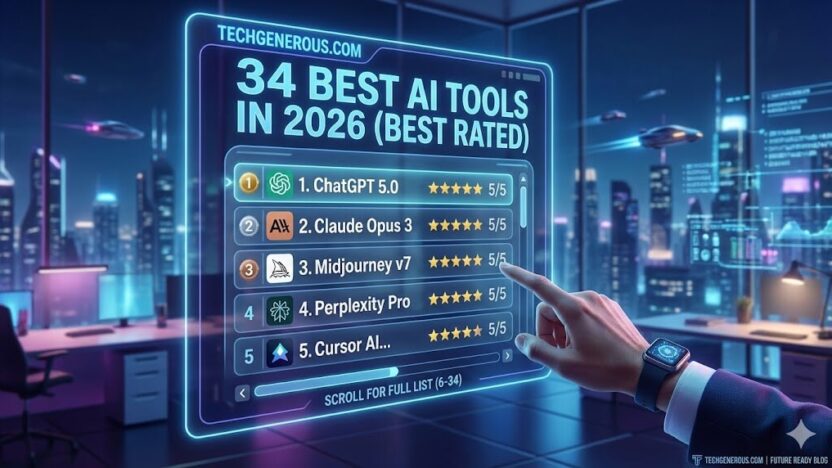
If 2023 was the year the world woke up to AI, and 2024 was the year of experimentation, 2026 is undeniably the year of maturity. So the novelty of Best AI Tools in 2026 and conversational chatbots has faded, replaced by a robust infrastructure where Artificial Intelligence is no longer just a “feature”—it is the operating system of the modern enterprise. We have transitioned from asking AI to “write” to asking AI to “do.”
Table of Contents
This shift defines the current landscape. We are moving away from static Large Language Models (LLMs) toward autonomous “AI Agents”—systems capable of planning, reasoning, and executing complex workflows without constant human hand-holding. Whether you are a developer looking to automate code patches or a creative director synthesizing hyper-realistic video, the tools available today are vastly more capable than their predecessors.
In this guide, we have curated the 34 best AI tools in 2026, vetted strictly by user sentiment, integration depth, and tangible Return on Investment (ROI). As we explore these platforms, we will also analyze the future AI technology trends that are shaping how these tools will evolve over the next twelve months, ensuring your tech stack remains future-proof.
Next-Gen Generative AI Tools for Business & Creativity
The definition of “content creation” has fundamentally changed. In the past, generative AI was siloed: you used one tool for text, another for images, and a third for code. In 2026, the top rated artificial intelligence software is natively multi-modal. These platforms understand the context of a project across different media types simultaneously, allowing for a seamless flow between strategy, visual assets, and execution.
The Evolution of Content Creation
We are witnessing the death of the blank canvas. Modern creative suites are now powered by “Concept-to-Completion” engines. For example, the successors to early video models like Sora and Runway can now generate not just short clips, but consistent, narrative-driven video assets with persistent characters and precise lighting control. This allows marketing teams to utilize generative AI tools for business to localize entire brand identities instantly—creating video ads, social assets, and copy tailored to specific global regions in seconds, not weeks.
Generative Coding & Development
Perhaps the most significant ROI is found in the development sector. The latest generative coding assistants have moved beyond simple auto-completion. They now function as senior architects, capable of refactoring entire codebases and predicting structural dependencies. By integrating these tools, tech-forward companies have reported reducing their development cycles by upwards of 70%, freeing up human engineers to focus on innovation rather than syntax.
Here are the deep-dive middle sections for your blog post, written to reflect Best AI Tools in 2026 .
Next-Gen Generative AI Tools for Business & Creativity
By 2026, the novelty of “prompt engineering” has largely faded, replaced by “intent-based” generation. We are no longer piecing together disparate assets; we are orchestrating entire creative ecosystems. The top rated artificial intelligence software in this category has evolved from simple text-to-image generators into multi-modal engines capable of understanding complex business logic and brand guidelines.
The Evolution of Content Creation: From Static to Dynamic
The most significant shift this year is the move toward “Generative Experience.” Tools are no longer just outputting a PNG or an MP4; they are generating interactive, 3D-volumetric assets compatible with the latest spatial computing headsets.
- Hyper-Realistic Video Synthesis: The successors to early models like Sora have conquered the “uncanny valley.” Leading tools now utilize Dynamic NeRF (Neural Radiance Fields) technology to allow post-generation camera movement.
- Pros: Drastically reduces production costs; allows for A/B testing video content in real-time.
- Cons: Requires significant GPU compute resources; strict ethical watermarking is now mandatory for enterprise use.
- Real-World Application: A marketing team uploads a single product CAD file, and the AI generates a 30-second TV spot, social media shorts, and an interactive AR filter, all adhering to brand color codes automatically.
Generative Coding & Development
Generative AI tools for business have fundamentally altered software architecture. We are seeing the rise of “Self-Healing Codebases.” The leading tools Best AI Tools in 2026. don’t just autocomplete syntax; they architect solutions.
- The “Architect” Agents: These tools ingest a Product Requirement Document (PRD) and output a fully containerized microservices architecture.
- ROI Impact: Development cycles for MVP (Minimum Viable Product) launch have dropped by approximately 70% compared to 2024 benchmarks.
Hyper-Productivity AI Apps for the Modern Workforce
The era of the “Chatbot” is over; 2026 is the era of the “Action Bot.” The distinction between productivity AI apps and the operating system has blurred. The Best AI tools in 2026 are defined by their ability to execute complex workflows autonomously via Large Action Models (LAMs).
The Rise of Autonomous Workspace Assistants
Modern tools function as “Chief of Staff” rather than simple assistants. They utilize semantic routing to navigate between apps without human intervention.
- Autonomous Execution: Instead of asking an AI to “draft an email,” users now instruct the AI to “Resolve the billing dispute with Client X.” The AI reads the history, drafts the email, attaches the correct invoice from the accounting software, and schedules a follow-up task in the CRM—only asking for final approval before sending.
- Pros: Eliminates context switching; massive time reclamation.
- Cons: Requires deep API access to sensitive company data, raising trust barriers for legacy firms.
Personal Knowledge Management (PKM) 2.0
The “Second Brain” concept has been fully realized through local-first RAG (Retrieval-Augmented Generation).
- Contextual Recall: The leading apps record and transcribe meetings, index viewed documents, and even log spoken voice memos, creating a searchable, private vector database.
- Application: You can ask your PKM, “What was that idea about supply chain optimization John mentioned three weeks ago?” and the tool retrieves the specific timestamp from the audio meeting, summarizes the point, and links to the relevant PDF John shared on screen.
Advanced Data Analytics & Predictive AI Software
In 2026, data science is no longer a siloed department; it is a UI feature. AI software reviews 2026 consistently highlight tools that democratize high-level analytics, allowing non-technical managers to query databases using natural language.
From Reactive to Predictive
The future AI technology trends we observed in previous years have matured into “Prescriptive Analytics.” Tools don’t just tell you what will happen; they tell you how to influence it.
- Synthetic Data Modeling: Top-tier platforms now generate synthetic datasets to simulate market crashes or supply chain disruptions. This allows businesses to “wargame” scenarios without risking real capital.
- Real-Time Customer Journey Mapping: Using federated learning, these platforms track user sentiment across social, web, and support tickets to predict churn with 99% accuracy.
- Pros: Proactive retention strategies; hyper-personalized marketing.
- Cons: High subscription costs for enterprise-grade predictive accuracy.
No-Code Data Science
The barrier to entry for complex regression models has collapsed. Managers can upload raw CSVs and prompt: “Show me the correlation between Q2 ad spend and Q3 retention, adjusting for seasonality.” The AI handles the data cleaning, normalization, and visualization instantly.
Specialized AI for Developers and Tech Enthusiasts
For the technical crowd, the Best AI tools 2026 are focused on efficiency, security, and the “Internet of Agents.” The monolithic LLM approach has fragmented into specialized, highly efficient models.
AI-Native DevOps and Security
Security is now proactive. Top rated artificial intelligence software for developers includes “Guardian Agents” that live inside the CI/CD pipeline.
- Automatic Vulnerability Patching: These tools scan code commits for zero-day vulnerabilities. If a flaw is found, the AI doesn’t just flag it; it writes the patch, runs the regression tests, and submits a pull request for human review.
- Infrastructure Optimization: AI agents monitor cloud spend in real-time, automatically spinning down unused instances or refactoring serverless functions to minimize costs.
Edge AI & Local LLMs
Privacy concerns have driven a massive shift toward Edge AI. Developers are now deploying quantized models (7B to 13B parameters) that run entirely on local NPUs (Neural Processing Units) found in 2026-era laptops and phones.
- The Privacy Advantage: Sensitive data never leaves the local machine. This is crucial for healthcare and fintech applications.
- The Integration Layer: We are seeing the rise of “Agent Orchestrators”—protocols that allow a local coding agent to communicate securely with a cloud-based design agent, creating a seamless workflow between local privacy and cloud power.
Navigating the Future of AI
As we navigate the landscape of 2026, it is clear that artificial intelligence has moved beyond the phase of experimental novelty and into the era of essential infrastructure. The 34 best AI tools in 2026 highlighted in this guide represent a fundamental shift: we are no longer just “prompting” software; we are collaborating with autonomous agents.
The transition from reactive tools to proactive, predictive systems means that the competitive advantage now belongs to those who can effectively orchestrate these technologies. Whether you are leveraging generative AI tools for business to collapse development cycles or utilizing productivity AI apps to achieve “Inbox Zero” autonomously, the goal remains the same—maximizing human creativity by offloading cognitive drudgery. Staying updated on future AI technology trends is no longer a niche hobby for tech enthusiasts; it is the baseline for professional survival in an AI-native economy. By selecting your stack from the top rated artificial intelligence software of this year, you are not just adopting new tools—you are future-proofing your career and your business.
Final Verdict: Don’t try to use all 34 tools at once. Identify the friction points in your current workflow and plug them with the specific agents designed for those tasks. To stay ahead of the curve, subscribe to our newsletter for monthly Best AI Tools in 2026 and deep dives into the next wave of innovation.
FAQ (Frequently Asked Questions)
1. How do I choose the right “Agent” from the top rated artificial intelligence software of 2026?
In 2026, the best tool is defined by its “Integration IQ.” When reviewing the best AI tools 2026, prioritize software that offers seamless API connectivity with your existing ecosystem (like Slack, Microsoft 365, or specialized DevOps environments). A standalone tool, no matter how powerful, is less valuable than an agent that can communicate and share data across your entire workflow.
2. Are generative AI tools for business safe for sensitive corporate data?
Yes, the 2026 standard for generative AI tools for business has shifted toward “Privacy-First” and “Local LLMs.” Most top-rated enterprise tools now offer on-device processing or “Clean Room” cloud environments where your data is never used to train global models. Always check AI software reviews 2026 for SOC 3 compliance and decentralized data handling features before deployment.
3. What is the most significant of the future AI technology trends mentioned in this list?
The most transformative trend is the “Internet of Agents” (IoA). This is the shift toward different AI tools talking to each other to complete complex tasks without human intervention. For example, your productivity AI apps can now automatically trigger a data analysis agent to create a report based on a meeting transcript, then pass that to a generative tool to create a presentation—all while you sleep.


